In addition to their own research explorations of the uses and misuses of artificial intelligence strategies, CCS faculty and staff often serve as informed commentators on issues that continue to emerge with the deployment of these technologies. Between late 2025 and the first half of 2026, CCS researchers were asked to weigh in on a...

Category: <span>Press Highlights</span>
Kicking Hitchhiking Stalkers Off GPS
Stalking has become a major issue in the U.S., with one 2024 study noting that some 13.5 million people are stalked each year and that about one in three women and one in six men will experience stalking at some point in their lifetime (See the report from the Domestic Violence Services Network, Inc.). Unfortunately,...
Software Supply Chain Framework in-toto Graduates from CNCF
In April, 2025, the Cloud Native Computing Foundation® (CNCF), announced the graduation of in-toto, a ground-breaking software supply chain security framework developed at the NYU Tandon School of Engineering. Achieving graduation status means in-toto has undergone rigorous review by the CNCF that included publishing end-user case studies and enhancing governance and onboarding practices, and has...
NYU CCS and Abu Dhabi Researchers Identify Significant Security Risks in Labs-on-chips
Labs-on-chips is an exciting new medical technology that enables technicians to perform multiple laboratory tests on tiny fluid samples, such as blood droplets. Unfortunately, malicious parties are already finding ways to tamper with these devices and affect their functionality. In a study published last fall in Scientific Reports, a team of researchers from CCS and...
NYU Abu Dhabi Post-Doc Scores Cover Story for Securing Biochips Paper
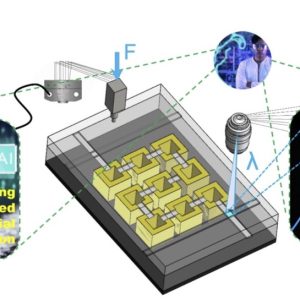
Figure Caption: An illustration of two countermeasures to address material-level attacks on microfluidic biochips. On the left, an ML-based material authentication scheme where a simple punch test (F), coupled with a load cell, can authenticate whether the material’s composition is correct. On the right, a laser shining UV light (λ) on the dye-doped microvalve, provides...
Getting real about AI ChatBots
Image by Mohamed Hassan from Pixabay Are important issues regarding the use of artificial intelligence tools getting lost in a swirl of speculation about their emerging “personalities”? A recent article in Popular Science suggests that “humanizing” generative AI chatbots could be distracting programmers and designers “from more serious and immediate dangers of the developing technology.”...
Ransomware hack at the Met confirms “nobody is safe.”
When contemplating where hackers will strike, perhaps the last target to come to mind would be the box office of an established cultural institution like New York City’s Metropolitan Opera. Yet, on December 7, attackers did just that. The hack prevented ticket sales, forcing its staff to revert to hand-printed tickets that sold for a...
CfD/Global Witness Study Finds Facebook Accepted Threatening Ads
In a test of how well social media outlets enforce their policies about harmful content in advertising, Facebook clearly fell short during the US midterm elections. A study conducted by Global Witness and NYU’s Cybersecurity for Democracy (C4D) found that Facebook either failed to detect, or just ignored, death threats against election workers contained in a...
FauxPilot: AI-assisted code generation with no strings attached
Want the benefit of an AI-assisted code generation program like GitHub Copilot, but don’t want to be tethered to the Microsoft universe? Dr. Brendan Dolan-Gavitt has developed an alternative. In the summer of 2022, the assistant professor of computer science and engineering at NYU’s Tandon School of Engineering introduced the cheekily-named FauxPilot. The primary goal...
Cappos: Major security problems can start with minor bits of code
Software programs can often be brought down by “some seemingly insignificant component, without which it fails.” Thus writes David Geer in a commissioned article in Communications of the ACM that looks at “how software stays so fragile despite industry efforts to stabilize it.” The article, published in October, examines “tendencies and trends” that “inflate coding errors”...