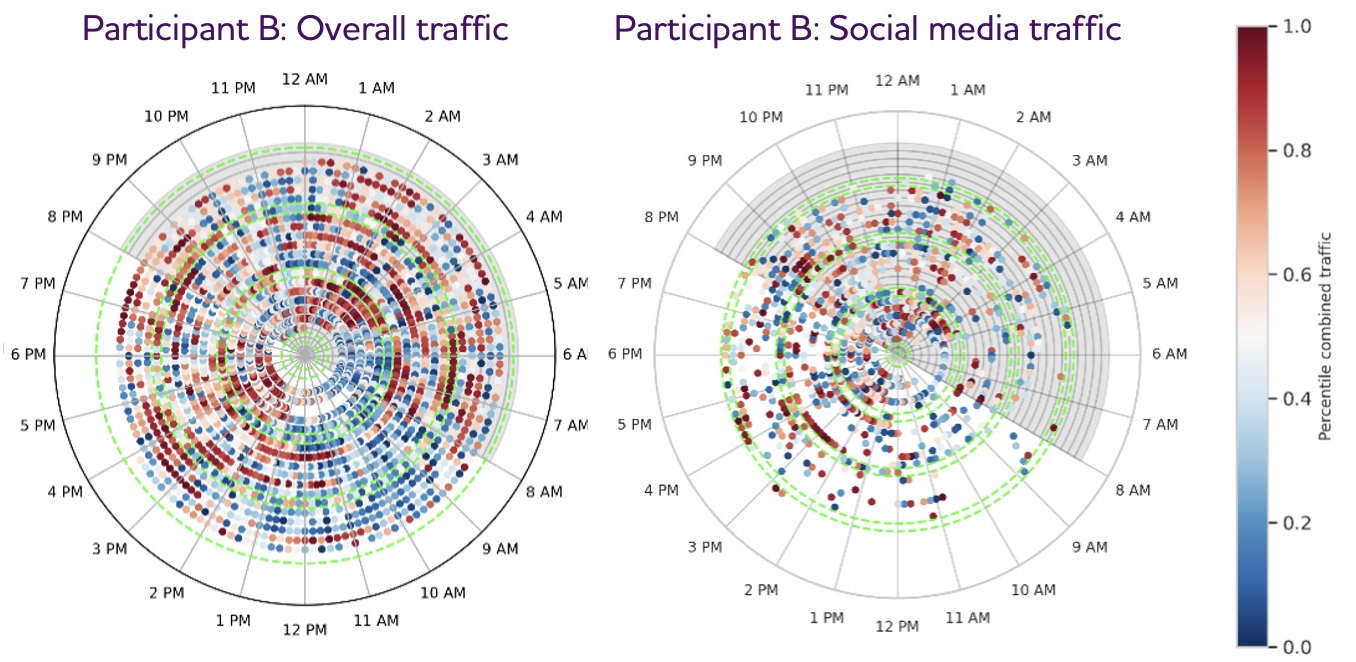
Figure showcases data from one participant in the 14-day pilot study with 27 NYU students that demonstrated the accuracy of the RouterSense technique.
A research team from NYU Tandon has found a better way to monitor human health, one that doesn’t require invasive wearables or rely on inherently subjective self-reporting. Called RouterSense, the system is able to track behaviors that can point towards conditions ranging from mental health struggles in young adults to early signs of Alzheimer’s disease in seniors. The secret sauce? Passive analysis of encrypted network traffic on a person’s smartphone or other digital device.
The analytical technique RouterSense employs has long been used in cybersecurity applications to detect unusual communication patterns RouterSense flips the script a bit by tracking an individual’s normal smartphone patterns and using them “as proxies for digital biomarkers,” according to CCS faculty member Danny Y. Huang. Citing a few examples, Huang, an NYU Tandon assistant professor with appointments in the Electrical and Computer Engineering Department, Computer Science and Engineering Department, as well as CCS, notes that “screen time can indicate sleep patterns, texting frequency reflects social interaction, and app usage reveals productivity rhythms.”
A paper published in the Journal of Medical Internet Research this year documents the multiple advantages of RouterSense, particularly when contrasted with existing methods used to scan for health issues. Because it only captures metadata, rather than the activity itself, the system keeps messages, videos, and other online activity private. The approach is also versatile enough to work across a diverse set of devices, such as phones, tablets, and PCs, whether they run on Apple, Android, or Windows systems.